Chennai is Simmering: Why More Concrete Means More Heat, and How We Fix It

Look, if you’ve spent over 25 years growing up in Chennai like I have, brutal summers are nothing new. We’ve basically been conditioned to survive the relentless humidity, dripping in sweat, and that unannounced sudden summer power cuts right when you're trying to fall asleep. For the longest time, we just shrugged it off, cranked up the fan (when the electricity was actually on).
But lately, the heat feels different. It’s heavier, it lingers longer into the night, and it turns out there’s a massive structural reason for it. I recently stumbled upon an eye-opening study by the Tamil Nadu Green Climate Company (TNGCC) that perfectly explains the reasoning behind it.
Breaking Down the Land Use

Fig. 1: Land use map of Chennai
When you look at the actual spatial data of our city, the reality is stark. Take a look at the land use map of Greater Chennai (fig 1)
The map paints a very clear—and mostly orange—picture:
-
The Concrete Monopoly: A staggering 80% to 85% of Chennai is now completely built-up. As our population has boomed over the last few decades, we’ve aggressively swapped out natural landscapes for high-rise apartments, industrial estates, and massive commercial complexes.
-
The Green Deficit: On the flip side, only about 3% of the city remains as designated green area.
-
Whats left: The only notable saving graces holding the line are a few scattered city parks like the Guindy park, the vital Pallikaranai marshland ecosystem in the south and the few remaining farmland/wasteland in the north.
Essentially, we have engineered our own concrete jungle, and we are getting cooked (literally).
The Urban Heat Island (UHI)

Fig. 2: Heat zones across Chennai
The consequences of this concrete expansion become crystal clear when you compare the land use map to the heat zone map shown in Fig 2.
There is an undeniable, direct correlation between where we live and how much we roast:
-
High-Heat Microclimates: These are the bright red and dark orange patches in image. Areas like the SIDCO Industrial Estate in Ambattur, the bustling Koyambedu market, and the Kodungaiyur dump yard are classified as high to extremely high heat zones. Why? Because concrete, asphalt, and tar absorb solar radiation all day and trap it, radiating heat long after the sun goes down.
-
The Cooling Effect: Now, look at the green patches at the bottom of the map near the Pallikaranai marshland and surrounding open zones. They map directly to the low and extremely low heat zones. Trees and natural wetlands don't trap heat; they provide natural shade, cool the air and breathe freshness naturally.
What can we do?
We can't just retreat into our air-conditioned bubbles and hope the problem goes away. In fact, a staggering 71% of Chennai’s greenhouse gas emissions come from energy consumption in buildings, mostly driven by the heavy use of thermal power for air conditioning. Our current coping mechanism is actively making the outdoor air hotter.
We can't just sit around waiting for the weather to miraculously change. The TNGCC study highlights a few critical, actionable steps that we, as citizens, can take to reclaim our neighborhoods from this extreme heat:
1. Starts with your home
- Cool Roofs: One of the easiest fixes is using highly reflective materials or white cooling tiles on our rooftops. This bounces the solar radiation than absorbing it.
- Solar panels: If you can setup solar panels on your rooftop to generate electricity, reduce the load on the grid.
-
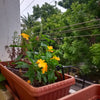
Terrace & Vertical Gardens: Alternatively, utilize your terrace or balconies by setting up potted plants and green canopies intercepts the sun before it hits the bare concrete floor.
- Also inspired by RK Pattarai's roof garden
2. Improve your community space
-
Plant Native Trees: We need to plant shade-giving, native trees along our compound perimeters and vacant plots.
-
Create Pocket Parks: Work with local Resident Welfare Associations (RWAs) to turn neglected neighborhood corners or empty community dumps into tiny pocket parks or community gardens.
3. Get the govt to build out public infrastructure
-
Community Heat Shelters: We need to actively advocate for and set up shaded "heat shelters" in high-footfall public areas. Think green canopies over exposed bus stands, shaded roofing over open-air local markets, and extensive tree-planting around government school campuses to protect kids during peak afternoon hours.
- Singapore is recently experimenting with air-cooled bus stops, while most other bus stops at least have a fan to provide some relief for their passengers.

What the GCC Must Do: Smart Infrastructure
While citizen action provides the foundational groundswell, the Greater Chennai Corporation (GCC) must step up with institutional fixes. Crucially, we need to transform how we execute public greening along our transport corridors.
Right now, watering avenue trees and road medians relies heavily on manual water lorries. This legacy system is fundamentally flawed: it blocks traffic on already congested roads, wastes immense amounts of water through inefficient spraying, and results in a significantly lower survival rate for young saplings.
The GCC needs to transition to automated drip irrigation systems integrated directly into pathways and road medians. Automated systems deliver targeted water right to the roots, maximizing water efficiency, keeping traffic moving, and drastically increasing sapling survival rates.
Furthermore, the GCC should focus on targeted interventions in very high-risk wards (such as Sowcarpet, Purasaiwakkam, and slum settlements along the coast) by establishing street tree corridors, pocket parks, and reflective pavements to cool high-footfall commercial zones.
The Cost of Inaction
Whenever large-scale urban greening is proposed, fiscal skeptics ask: What will this cost?
But we should really be asking: What is the cost of doing nothing?
-
In 2023 alone, Tamil Nadu suffered 12 heatwave-related deaths.
-
The state has officially notified heatwaves as a 'state-specific disaster,' committing 4 lakh in relief for victims' families
The cost of treating heatwaves as an ongoing disaster—paying out relief funds, dealing with spiking healthcare crises, and managing grid failures from soaring AC demands—far outweighs the upfront capital needed for better planned urban greening as outlined in its research.
By shifting our focus to greening our own corners, we can slowly start turning these red heat zones back to green.
-
Posted in
chennai, green climate company, greenspace, heatwave, urban planning