How this Farmer intercropped Tapioca in his Coconut Grove
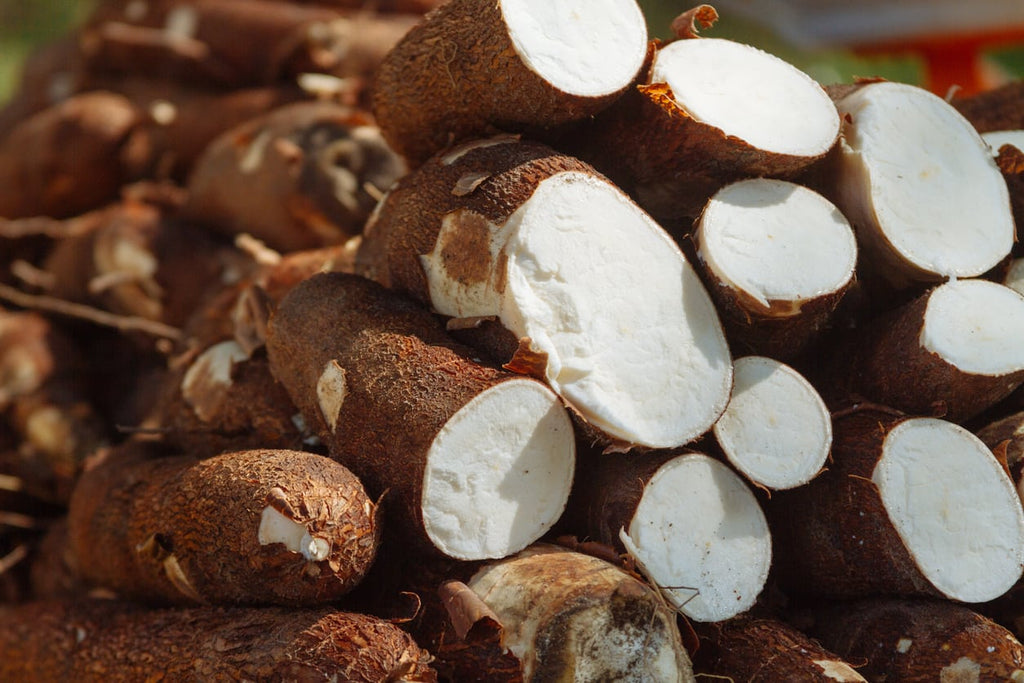
Walk into almost any kitchen or food industry in India, and you'll find the footprints of tapioca. From the beloved javvarisi (sago) payasam served at weddings to essential industrial starches, flours, and biodegradable pellets, tapioca is an absolute powerhouse of a crop.
What many don't realize is that Tamil Nadu stands as the largest producer of tapioca in India. The state's climate is ideal for this root crop, but there’s a catch—tapioca requires consistent, heavy watering to develop healthy, starch-rich tubers. For agriculturalists trying to balance precious water resources, traditional flooding methods just won’t cut it anymore.
Enter Kandhasamy, an innovative farmer from Rasipuram taluk in the Namakkal district. Managing a 1-hectare (1ha) field primarily dedicated to coconut trees, Kandhasamy realized he was sitting on an untapped asset: the wide, vacant soil lanes running right between his trees. He decided to maximize this interspace by planting tapioca, completely revolutionizing his yield using precise inline drip irrigation system.
Precision Inline Irrigation
Because tapioca demands uniform moisture to prevent root rot while maximizing starch accumulation, traditional open-channel watering is highly inefficient. Kandhasamy solved this by introducing an advanced AGS Irrigation solution featuring precision drip irrigation laterals with internal emitters built right inside the tube.
Unlike external online drippers that can get easily clogged, these advanced drip irrigation tubes feature factory-spaced intervals that are spaced based on the plant spacing of 1.2mx0.6m, which deliver water seamlessly to the roots. By shifting to a highly efficient drip line irrigation system, evaporation losses are practically reduced to zero because water is applied directly beneath the canopy. Furthermore, because moisture is restricted strictly to the crop rows, the vacant interspace stays dry, which naturally suppresses weed growth and drastically cuts down on manual weeding labor.

This specific setup utilizes precise holes calibrated for 4 or 8 liters per hour, ensuring that water is delivered at a rate the soil can naturally absorb without pooling. Beyond just supplying water, these precise drip irrigation fittings and inline configurations allow Kandhasamy to implement precise fertigation—mixing water-soluble nutrients directly into the flow to feed the tapioca roots exactly what they need, right when they need it. This uniform moisture distribution ensures the tubers grow evenly, preventing cracking and significantly driving up the overall tonnage per hectare for a premium, high-yield harvest.
Seeing is Believing
To appreciate what professional agricultural drip irrigation design can do for a farm, you only have to look at the visual timeline of Kandhasamy’s 1ha estate.
Before


Initially, the field featured spacious, unutilized ground between rows of young coconut palms. We see the bare, dry, red soil of Namakkal before the cultivation took off. The space was wide open but completely underutilized, producing nothing while the coconut trees matured.
After inline lateral installation


Kandhasamy stands proudly next to his newly installed filtration, valves, and drip irrigation pipe control manifold—the brain of the entire automated system.
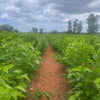
The barren ground has completely vanished under a lush, dense, vibrant green canopy of thriving tapioca crops. The robust drip irrigation lateral lines can be seen snaking perfectly along the ridges, feeding the crops with pinpoint accuracy.
Today, Kandhasamy enjoys the ultimate farming victory: less manual effort, optimized water consumption, and a highly profitable double-income harvest from a single piece of land. Intercropping tapioca with a reliable inline drip irrigation system isn't just smart agriculture; it's the future of sustainable farming in Tamil Nadu.
-
Posted in
drip irrigation, inline lateral, irrigation tube with emitter, PMKSY