What Is the Cost of a Drip Irrigation System Per Acre in India?
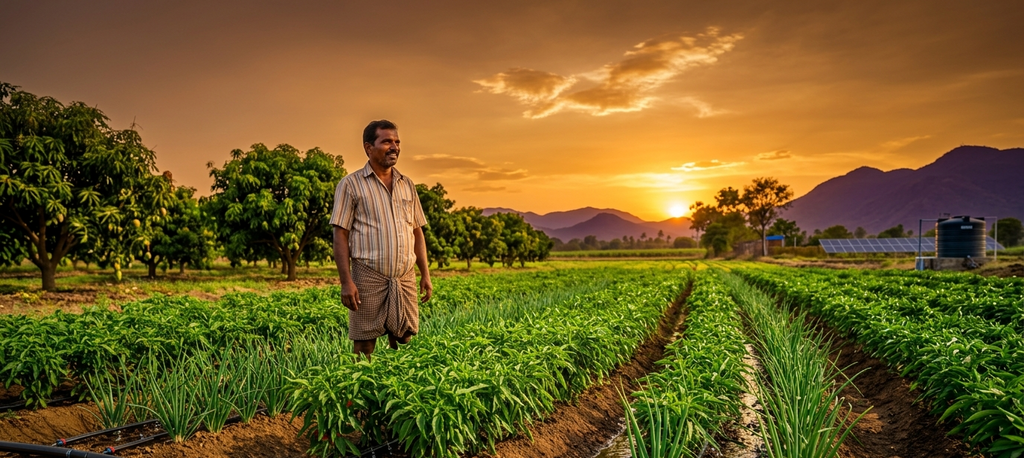
Picture this: your neighbour’s farm — same soil, same rainfall, same crop — is consistently yielding 40% more than yours, spending less on water and fertilizer, and spending far fewer hours in the field. The difference isn’t luck. It’s a drip irrigation system. If you’ve been thinking about making the switch, the question isn’t whether it’s worth it. It’s how much does it cost — and more importantly, how much of that cost do you actually have to pay?
The answer will surprise you.
Indian Government cost estimate
Most farmers hear a figure from a neighbour or a passing salesman and assume that’s the price. But the cost of a drip irrigation system in India isn’t a single number — it varies based on your farm size, your crop, the spacing between your plants, and the state you farm in. Quote the wrong inputs and you’ll plan for the wrong budget.
There is, however, a government-published reference framework that removes the guesswork entirely. The Government of India’s Per Drop More Crop (PDMC) scheme publishes standard indicative costs for drip and sprinkler irrigation systems across different farm sizes and crop spacings. These aren’t prices set by any company — they’re official benchmarks built from Bill of Quantities (BoQ) exercises that account for every component in a drip irrigation system: drip irrigation pipes, drip line irrigation laterals, drip irrigation fittings, filters, valves, and installation.
These figures give you a solid, defensible starting point — before anyone quotes you anything.
What Actually Goes Into an Irrigation System?
A farm irrigation system is far more than just a drip irrigation pipe laid across the ground — it has five distinct components, each with its own function and cost contribution.
1. Head Unit
The head unit is where water enters the system. It includes your pump (electric, diesel, or solar), pressure gauge, non-return valve, throttle valve, and bypass assembly. The pump lifts water from your source — borewell, open well, canal, or tank — and pressurises it to the level the rest of the system needs. Drip irrigation systems typically run at 1–2 kg/cm²; sprinkler systems need 2–4 kg/cm². Getting the pressure right at the head unit is what makes everything downstream work properly.
2. Filter Unit
Unfiltered water is the single biggest reason drip systems fail. Sand, silt, algae, and mineral deposits clog emitters and shorten your system’s life. The filter unit sits between the pump and the mainline and typically includes one or more of: a screen or disc filter (for clear water with fine particles), a sand or media filter (for water with organic matter or algae), and a hydrocyclone separator (for sandy borewell or canal water). The right combination depends entirely on your water quality.
3. Fertigation Unit
One of the biggest advantages of a drip line irrigation system is the ability to feed your crops through the water line itself. The fertigation unit — a venturi injector, fertilizer tank, or automated dosing system — dissolves soluble fertilizers directly into the irrigation water. Nutrients reach the root zone in precise doses, reducing fertilizer waste and improving absorption significantly. Under the PDMC scheme, at least one fertigation device is compulsory in drip systems.
4. Mainline and Sub-main Piping
Water flows from the head unit through the mainline to the sub-mains, which distribute water across different zones of your farm. This piping network is usually buried underground. Two materials are commonly used: PVC pipes are the standard choice for mainlines in flat terrain, while HDPE pipes are preferred for hilly or undulating land and sprinkler systems due to their flexibility and pressure rating. Control valves and drip irrigation fittings on each sub-main let you irrigate different sections independently.
5. Lateral Lines and Emitters
This is the last mile of the system — the thin drip irrigation pipes that run along each crop row, delivering water directly to each plant. Two types are used: online laterals with separate drippers are suited to orchards and wider-spaced crops where emitters are clipped onto the tube at each plant, while inline emitter tubes have drippers factory-built inside the tube at fixed intervals, ideal for closely spaced row crops like vegetables, sugarcane, and banana. Crop spacing is the single biggest driver of system cost — a tightly spaced vegetable crop at 1.2m × 0.6m needs nearly five times the drip line lateral length of a coconut orchard at 6m × 6m over the same area.
How the Five Parts Connect: System Layout
The two diagrams below show how a complete drip and sprinkler system is laid out on a real farm — from the water source through to each plant.
Drip Irrigation System Layout

Sprinkler Irrigation System Layout

Water enters at the head unit, gets filtered, picks up dissolved nutrients from the fertigation unit, travels through the buried mainline and sub-mains to each zone, and finally reaches the crop through the drip irrigation lateral lines and emitters or sprinkler nozzles.
So What Does It Actually Cost Per Acre?
Here are indicative costs from the PDMC 2025 guidelines for drip irrigation in Tamil Nadu and Andhra Pradesh. Since most farmers in India plan in acres, we’ve included both units — 1 hectare = 2.47 acres.
| Crop (example) | Spacing | 1 ha / 2.47 acres | 2 ha / 4.94 acres | 5 ha / 12.35 acres | Per acre (approx.) |
|---|---|---|---|---|---|
| Coconut, Mango, Teak | 6 × 6 m | ₹34,687 | ₹57,987 | ₹1,42,566 | ₹14,050 |
| Banana, Sugarcane | 1.8 × 0.6 m | ₹91,560 | ₹1,73,298 | ₹4,42,484 | ₹37,070 |
| Vegetables, Chilli, Onion | 1.5 × 1.5 m | ₹97,245 | ₹1,85,324 | ₹4,70,306 | ₹39,370 |
| Tomato, Brinjal (inline) | 1.2 × 0.6 m | ₹1,27,501 | ₹2,42,422 | ₹6,19,326 | ₹51,620 |
For most vegetable and horticultural crops, a drip irrigation system costs roughly ₹35,000 to ₹52,000 per acre before government support — and as you’ll see below, in Tamil Nadu and Andhra Pradesh that cost is largely or entirely covered by subsidy.
Ready to see the number for your farm? Use our free irrigation cost calculator — enter your state, farm size, and crop spacing to get your reference cost in under a minute.
What the Cost Includes — and What It Doesn’t
Included: mainline and sub-main piping, drip irrigation lateral tubes, emitters or sprinkler heads, screen filter, venturi/fertigation device, control valves, flush valves, drip irrigation fittings, and basic installation labour.
Not typically included: the pump and motor (submersible pumps are a significant separate cost), civil trenching, electrical connections, and optional add-ons like sand filters, hydrocyclone separators, or automation systems.
You May Be Eligible for Significant Government Subsidy — With No Upfront Cost
This is where the picture changes significantly. The PDMC scheme provides direct financial assistance to farmers who install drip or sprinkler irrigation systems — and in Tamil Nadu and Andhra Pradesh, the support is substantial.
Subsidy rates where we operate
Tamil Nadu
- Small and marginal farmers: 100% subsidy — the full system cost is covered
- Other farmers: 75% subsidy — you pay only 25% of the reference cost
Andhra Pradesh
- All farmers regardless of holding size: 90% subsidy — you pay only 10% of the reference cost
The best part: there is no upfront cost to you. The subsidy is handled directly between the government and AGS Irrigation, so you don’t need to arrange funds, wait for reimbursement, or navigate the paperwork on your own. You simply come to us, confirm your eligibility, and we manage the rest.
Step-by-Step: How the Implementation Process Works
- Initial Assessment — You connect with us. We review your land, verify your state subsidy eligibility, and determine the exact reference cost for your crop spacing.
- Document Submission — Your application is prepared and submitted to the district Agriculture or Horticulture Department along with your land documents, Chitta/Adangal, and Aadhaar card.
- Official Work Order — The department conducts a baseline verification and issues an official pre-approval work order. Installation cannot begin before this order is secured.
- Professional Installation — The technical team at AGS Irrigation lays out the mainlines, fits the filtration units, and installs your drip irrigation lateral lines across the designated zones.
- Field Inspection — A designated government official or third-party inspector visits your farm to verify that the physical layout matches the approved Bill of Quantities.
- Subsidy Clearance — The government settles the subsidy balance directly with us. Your system is fully operational, and you are ready to cultivate with absolute peace of mind.
One important rule: subsidy can only be claimed on the same plot once every 7 years. The exception is switching from sprinkler to drip, which is permitted after 3 years to support crop diversification.
Ready to Optimise Your Farm’s Yield?
Every field has its own unique layout, and your path to a high-yield, low-stress harvest starts with accurate planning.
Use our interactive Irrigation Cost Calculator to generate a clear, reliable price baseline for your land size in under a minute. If you are ready to check your local subsidy eligibility, map out a custom quote, or schedule a field inspection, simply click below to chat directly with our team on WhatsApp.
-
Posted in
drip irrigation, drip irrigation cost India, drip irrigation per acre, farm irrigation cost, government subsidy, micro irrigation, PDMC, sprinkler irrigation