Mulberry farming for Silk: How a dharmapuri farmer sells high-grade silk
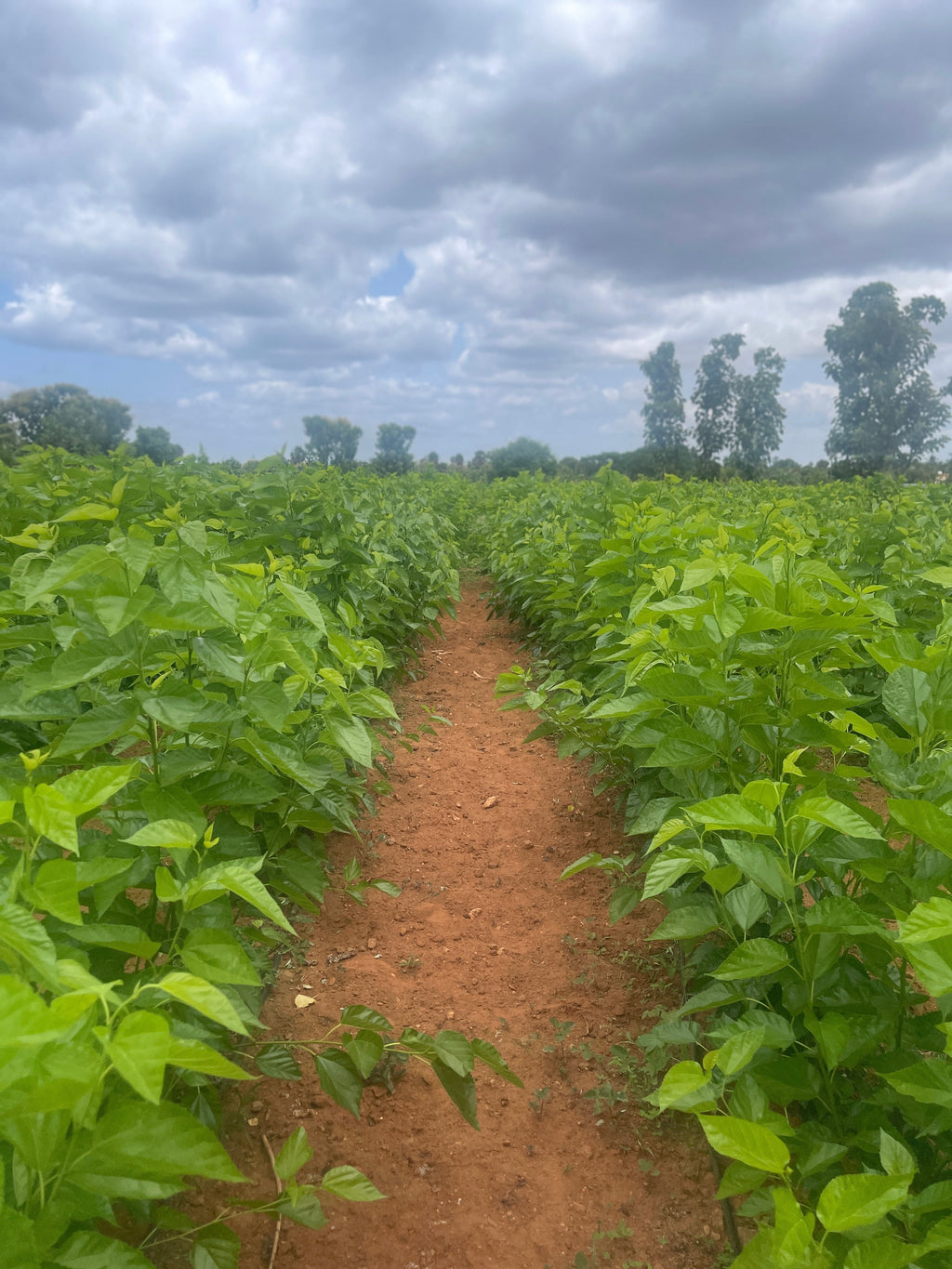
In Jarugu village, Nallampalli block, Dharmapuri district, a retired sub-inspector runs eight acres of farmland. About 80% of it is mulberry. The rest is coconut and teak.
He doesn't sell mulberry. He sells silk cocoons — and the mulberry is what makes them worth buying.
Lifecycle of a silkworm
Silk starts with a moth egg, laid by Bombyx mori — the domesticated silk moth.
Egg. Tiny, dark, sown in trays.
Worm. This is the stage that matters. The larva hatches and eats mulberry leaves almost continuously, moulting as it outgrows its own skin. Nothing else will do — mulberry is the silkworm's only food.


Cocoon. When it's fully grown, the worm spins a single unbroken filament of silk around itself. That one thread, wound into a cocoon, is what gets harvested.

Moth. If left alone the pupa becomes a moth. For silk production the cocoons are collected before that happens, because an emerging moth breaks the thread.
The whole cycle is short — a matter of weeks. Which means the leaf supply has to be constant.
Quality matters
Here's the part that matters for farmers.
The silkworm builds its silk entirely out of what it eats. Better leaf means a healthier worm, which means a denser, better-graded cocoon. Local buyers pay well for his cocoons specifically because his mulberry is thick and green rather than thin and stressed.
So the whole operation comes back to keeping the plant and the worm in thriving condition.
Hands-off Irrigation (Automation)
The mulberry runs on two systems:
Large sprinklers — including impact sprinklers — for overhead coverage across the rows.


Drip tube with emitters spaced at 40cm — running along the base of each row, putting water directly at the root.
The 40cm spacing matters. Mulberry is planted in close rows, and evenly spaced emitters mean every plant gets the same amount and provides 100% irrigation coverage.


The irrigation is fully automated and controlled from his phone. No one walks the field to open valves.
For a farm this size that's the difference between irrigation being a daily job and irrigation being something that simply happens. It also means watering can run on schedule rather than on whoever is available.
The rearing room at 26°C
The worms live in a small climate-controlled room held at 26°C.
Silkworms are sensitive to temperature. Too hot or too cold and they eat less, grow unevenly, and spin poorer cocoons. Holding a steady 26°C keeps the batch developing together, which is what produces a uniform, high-grade harvest.
What's left for people to do
With irrigation automated and the rearing room regulated, the labour has collapsed down to essentially one task: cutting mulberry and feeding the worms.
Given the silkworms' constant hunger, harvesting the mulberry still requires manual labour.
It's a neat piece of farm design. The technology handles what's repetitive — water and temperature — and the farmer's attention goes to the one thing that actually determines the value of the crop: keeping a very hungry silkworm well fed on very good leaves.
Growing mulberry, or any close-row crop? Our drip tube with emitters and sprinkler range are built for exactly this.
AGS Irrigation supporting farmers since 1983.
-
Posted in
automation, dharmapuri, drip irrigation, mulberry, sericulture, silk, sprinklers