My Room is 4°C Cooler thanks to my roof garden
A few months ago I wrote about why Chennai keeps getting hotter — 80-85% of the city built up, roughly 3% green, and every slab of concrete storing heat all day and releasing it into our bedrooms all night. At the end of that post I listed the fixes: cool roofs, solar panels, terrace gardens.
Then The Hindu published research that made me want to measure and verify the results from the IIT Madras study.
The Hindu reported on work by IIT-Madras and Okapi Research and Advisory across four Chennai sites — Adyar, Chromepet, Otteri and Adambakkam — at gardens set up by the Chennai Resilience Centre. Radiation and temperature sensors measured the roof surface, the ceiling below, and the air above the roof.
In Otteri, June 2022, the air above the planted roof was 35.7°C. Above the exposed roof beside it, 43.8°C.
A gap of 8.1°C. Same building. Same afternoon.
| What was measured | Reduction with a rooftop garden |
|---|---|
| Roof surface temperature | 8–12°C |
| Air temperature above the roof | up to 8.1°C |
| Ceiling temperature | 2–4°C |
| Indoor room temperature | 1–2°C |
My terrace, measured
I already had the setup to test this, so I took a thermometer up and read both halves of the roof.
Exposed roof: 35.6°C. Garden side: 31.2°C. Both at 7.30 AM.
A difference of 4.4°C, which lands within a fraction of what IIT-Madras recorded in Otteri with proper instruments.


My mother built it out of kitchen waste
The part I like most about this garden is that nobody planned it.
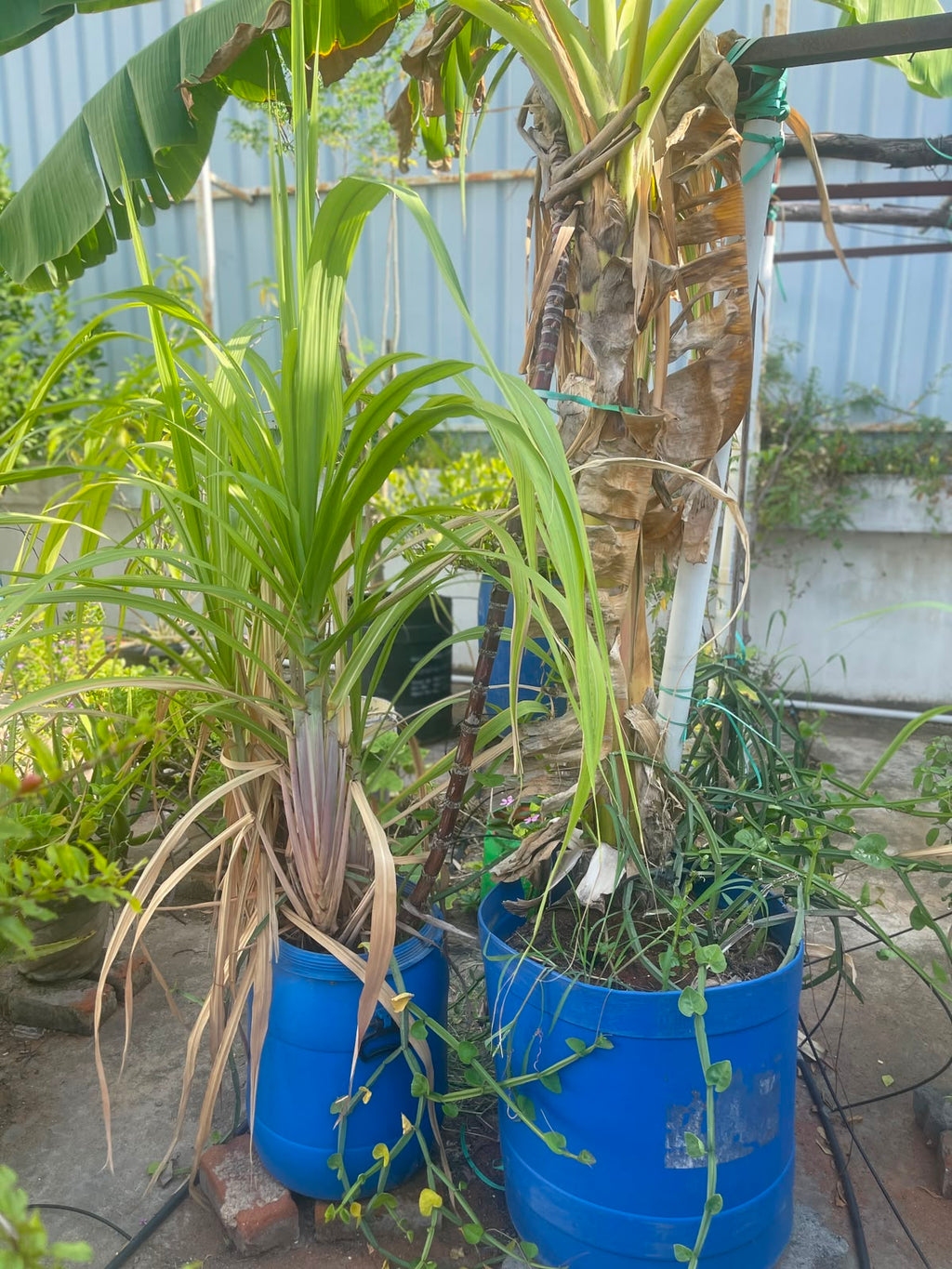
My mother started it. Whenever we bought fruit or vegetables, the seeds went into a pot, a grow bag, or one of the blue recycled drums on the terrace instead of the bin. No nursery, no plan, no cost. Some sprouted, some didn't. The ones that did stayed.
That's where the banana came from. And the watermelon, the pineapple, the lemon, the moringa, the guava and most of the trees up there now. The sugarcane went in after a Pongal — the leftover piece, pushed into a drum — and it just kept going.
Years of that, and the terrace filled in on its own. It's the by-product of not throwing seeds away, and it is now the source of most produce required for our daily meals.
Add solar and the two work together
In my earlier post I listed solar panels and terrace gardens as separate items. Having seen a friend's setup, I'd put them in the same line.
He has rooftop solar with potted plants underneath and around the panels. His ceiling and indoor temperatures dropped by roughly 2–4°C.
They help each other rather than just adding up. The panels shade the slab, so the concrete never takes the direct hit. The plants cool the air the panels sit in — and panels lose efficiency when they bake. Bare metal on bare concrete gets punishing. Panels over greenery don't.
Same square metre of terrace, doing three jobs: shade, generation, cooling.
The part most people get wrong
Read that table top to bottom. 8–12°C at the roof surface becomes 2–4°C at the ceiling becomes 1–2°C in the room.
A rooftop garden will not make your bedroom 8°C cooler. Each layer of concrete absorbs part of the benefit. Indoors it's 1–2°C, maybe 3 at peak — in Adambakkam the garden-covered room read 33.7°C at 5 p.m. against 37°C in the uncovered one.
The dramatic cooling is on the roof. The quiet, useful cooling is in the room. Both are worth having.
And that indoor degree or two isn't nothing. It's free, it happens every afternoon for years, and it hits hardest at exactly the hour your house is at its worst. For households where AC isn't an option — most of the city — a top-floor room that's 2°C less brutal at 5 p.m. is a real difference.
Why it works
Shade: Leaves and soil block sunlight before it reaches the concrete. The garden takes the heat instead of your slab.
Evapotranspiration Plants release water vapour, and that phase change pulls heat out of the air around them. Same reason a wet cloth on your neck cools you down.
Insulation: Soil conducts heat poorly. A layer of it between sun and ceiling slows the transfer.
Start with one section:
You don't need to convert the whole terrace. The study measured partially covered roofs and still found the effect.
- Ten to fifteen grow bags or old drums over the room you actually use — usually a top-floor bedroom or hall.
- Precise watering with drip irrigation, It puts water at the root instead of across the surface, so you use a fraction of what a hose costs you and you're not standing on a hot terrace every evening. Retrofitting it after you've killed a few plants is more annoying than installing it upfront.
- Start with kitchen seeds. It costs nothing and you find out what survives your roof.
- Expand when it does. Denser coverage, bigger effect.
What can help Chennai
The researchers aren't stopping at single buildings. They're asking what happens if 20–30% of the city's terraces become gardens — whether that moves the urban heat island itself rather than one room at a time.
My garden drops my roof by 8°C, my bedroom by a degree or two, and hands us fruit we didn't buy. A hundred thousand of them might change what a Chennai summer feels like.
The concrete is going to absorb everything the sun sends it either way. The only question is whether you leave it bare.
Study by IIT-Madras and Okapi Research and Advisory, at rooftop gardens set up by the Chennai Resilience Centre in Adyar, Chromepet, Otteri and Adambakkam. Reported in The Hindu.
-
Posted in
chennai, greenspace, heatwave, rooftop garden, urban planning