Thai Pattam Tomato Under Drip: Yield, Water & Care
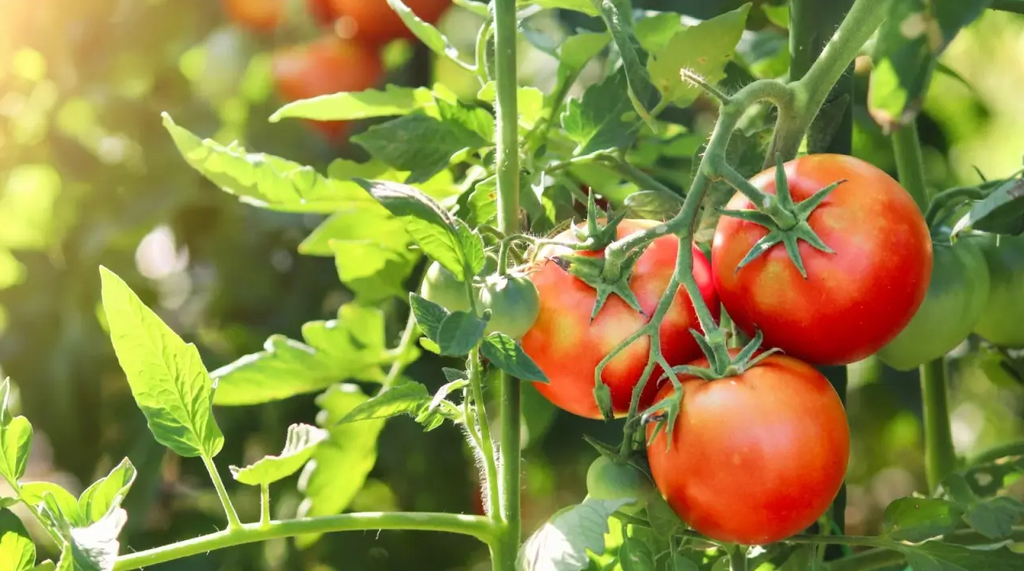
Tamil Nadu has two main tomato seasons. TNAU recommends sowing in May–June (Aadi pattam) and December–January (Thai pattam). If you plan to grow tomatoes this Thai pattam, the next six to eight weeks are when the decisions that set your yield get made: which variety, how you raise seedlings, how you lay the beds and drip lines, and how you plan water and nutrients. This guide walks through each step using recommendations from Tamil Nadu Agricultural University (TNAU), ICAR-IIHR and FAO.
Choose the variety first: it sets your yield ceiling
The variety decides how much you can harvest, how long the crop stands in the field and which diseases you need to worry about. Two well-documented options for Tamil Nadu:
| Variety | Type | Reported yield | Duration | Notes |
|---|---|---|---|---|
| Arka Rakshak (ICAR-IIHR) | F1 hybrid | 75–80 t/ha | About 140 days | Resistant to leaf curl virus, bacterial wilt and early blight. Fruits 90–100 g, square-round, deep red and firm. |
| PKM 1 (TNAU) | Variety | 30–35 t/ha | 135 days | Flat-round fruit with a green shoulder. Good for long-distance transport. |
Those are per-hectare figures from research and demonstration plots. In more practical terms:
- Arka Rakshak: 75–80 t/ha works out to roughly 30–32 tonnes per acre, or about 3.2–3.4 kg per plant at TNAU's recommended plant population (below).
- PKM 1: 30–35 t/ha is roughly 12–14 tonnes per acre, or about 1.3–1.5 kg per plant.
Treat these as the upper limit of what good management can reach, not a guarantee. Field yields depend on weather, pest pressure, soil and how closely the water and nutrient schedule is followed.
One caution on disease resistance: Arka Rakshak is not resistant to late blight. In a two-season trial in Karnataka published in the Journal of Horticultural Sciences, late blight caused an average yield loss of about 75% in Arka Rakshak. If your area sees cool, humid spells with late blight, plan protective sprays with your local agriculture officer.
Raise healthy seedlings (start about 25 days before transplanting)
TNAU's protray method gives uniform seedlings and fewer losses than open nursery beds:
- Seed: 100–150 g of hybrid seed per hectare (300–350 g/ha for open-pollinated varieties). Treat seed 24 hours before sowing with Trichoderma viride at 4 g/kg, or carbendazim at 2 g/kg.
- Medium: Sterilised cocopeat mixed with neem cake, Azospirillum and Phosphobacteria. About 1.2 kg of cocopeat fills one 98-cell protray.
- Sowing: One seed per cell. Cover, stack the trays and cover them with polythene until germination.
- Shade net: After 6 days, move the trays onto raised beds under a 50% shade net with insect-proof (40–50 mesh) sides. Keeping whiteflies off young seedlings is the first defence against leaf curl virus.
- Feeding: Water daily with a rose can. Drench with 19:19:19 at 3 g per litre at 18 days after sowing.
- Transplant at about 25 days old.
Lay out beds and drip lines before planting
TNAU's drip fertigation package for tomato uses this layout:
- Beds: Raised beds 120 cm wide with 30 cm paths between them.
- Laterals: One drip lateral along the centre of each bed, so laterals sit 1.5 m apart.
- Drippers: 4 LPH drippers every 60 cm, or 3.5 LPH every 50 cm.
- Planting: Paired rows at 90 × 60 × 60 cm. That is about 23,334 plants per hectare (around 9,400 per acre).
- Before transplanting: Basal-apply 25 t/ha of farmyard manure, mixing 2 kg each of Azospirillum and Phosphobacteria into 50 kg of it, plus 75% of the phosphorus dose as superphosphate. Then run the drip for 8–12 hours to wet the beds thoroughly.
TNAU also recommends mulching with 25-micron black LDPE sheet, with both edges buried 10 cm into the soil. The mulch holds moisture and keeps weeds down. Fill any gaps by replanting on the 7th day after transplanting.
If you're installing drip for the first time, our step-by-step drip installation guide explains mainlines, sub-mains, filters and laterals.
How much water tomato needs at each stage
FAO puts the total water need of a field tomato crop at 400–600 mm over the 90–120 days after transplanting, depending on climate. On one acre, that's about 16–24 lakh litres for the season, or roughly 170–260 litres per plant at TNAU spacing.
Demand isn't even through the season. FAO gives a crop coefficient (Kc) for each stage, which tells you what fraction of the day's evaporation the crop uses:
| Stage | Approx. length | Kc |
|---|---|---|
| Establishment | 10–15 days | 0.4–0.5 |
| Vegetative growth | 20–30 days | 0.7–0.8 |
| Flowering and fruit set | 30–40 days | 1.05–1.25 |
| Fruit ripening | 30–40 days | 0.8–0.9 |
| At harvest | – | 0.6–0.65 |
Turning this into drip run time. Daily crop water need (mm) = reference evaporation (ETo, mm/day) × Kc. One mm over one square metre is one litre. Your local ETo figure is in IMD or TNAU agro-advisories.
Worked example, using the TNAU layout above, where each dripper serves about 0.9 m² (1.5 m lateral spacing × 0.6 m dripper spacing):
- Peak demand: On a day with ETo of 4 mm, a crop at flowering (Kc 1.15) needs 4.6 mm. That's about 4.1 litres per dripper, or roughly 1 hour of run time with 4 LPH drippers.
- Establishment: At Kc 0.45, the same day needs about 1.6 litres per dripper, or about 25 minutes.
Run slightly longer than the calculation to allow for system losses. Short, frequent irrigations suit tomato better than occasional heavy ones.
Fertigation: feeding through the drip
TNAU recommends a total of 200:250:250 kg NPK per hectare for hybrid tomato under drip. Most of the phosphorus goes in at planting; nitrogen and potassium go through the drip in four stages:
| Stage | Days | N (kg/ha) | P (kg/ha) | K (kg/ha) |
|---|---|---|---|---|
| Transplanting to establishment | 10 | 20 | 12.5 | 25 |
| Flower initiation to flowering | 30 | 80 | 25 | 100 |
| Flowering to fruit set | 30 | 60 | 12.5 | 75 |
| Picking period (alternate days) | 80 | 40 | 12.5 | 50 |
TNAU's schedule supplies these nutrients with water-soluble 19:19:19, 12:61:0 and 13:0:45 plus urea. For an acre, divide each figure by about 2.5. Clogged drippers mean uneven feeding, so keep the filter clean and flush laterals regularly.
Micronutrients: TNAU recommends spraying 0.5% zinc sulphate three times at 10-day intervals from 40 days after planting, and 0.3% boric acid at flowering and again 10 days later.
Staking and weed control
- Staking: Stake plants 30 days after planting with 1–1.5 m stakes, and remove side shoots up to 20 cm above the ground. According to TNAU, staking makes spraying and picking easier, reduces buckeye rot and improves fruit quality.
- Weeds: TNAU advises a pre-emergence spray of pendimethalin or fluchloralin at 1.0 kg active ingredient per hectare on the 3rd day after planting, then one hand weeding at 30 days.
The two problems to watch for
Leaf curl virus (spread by whitefly)
Symptoms: stunted, bushy plants, leaves that curl downward and crinkle, and older leaves that turn leathery. There's no cure once a plant is infected, so prevention matters. TNAU recommends:
- raising seedlings under insect-proof net
- a border of sorghum, maize or bajra as a barrier crop
- yellow sticky traps at 5 per acre
- removing the weed host Abutilon indicum (thuthi) around the field
Choosing a resistant hybrid such as Arka Rakshak is the strongest protection.
Fruit borer (Helicoverpa armigera)
The larvae bore round holes into fruit and feed inside. TNAU's integrated approach:
- Plant 40-day-old American tall marigold as a trap crop, at one row for every 16 rows of tomato.
- Set Helilure pheromone traps at 12 per hectare.
- Release the egg parasitoid Trichogramma pretiosum at 1 lakh per hectare every 7 days from flower initiation.
- Pick and destroy damaged fruit.
- Bio-options: Bacillus thuringiensis at 2 g/litre, or azadirachtin 1% at 2 ml/litre sprayed in the evening.
If chemical control is needed, TNAU lists options such as chlorantraniliprole 18.5 SC at 3 ml per 10 litres. Always follow the label and your local agriculture officer's advice.
Frequently asked questions
How many tomato plants fit in one acre with drip?
About 9,400 plants, using TNAU's paired-row spacing of 90 × 60 × 60 cm (23,334 plants per hectare).
How much water does one tomato plant need?
About 170–260 litres over the season at that spacing (FAO: 400–600 mm per crop). Daily use peaks at flowering and fruit set, when the crop uses more water than the day's reference evaporation (Kc above 1).
When should I sow tomato in Tamil Nadu?
TNAU recommends May–June (Aadi pattam) and December–January (Thai pattam). Sow the nursery about 25 days before you want to transplant.
How much does drip irrigation cost per acre?
It depends on crop spacing, water source and how much area each valve covers. Our guide on drip irrigation cost per acre in India breaks it down.
Equipment you'll need
A drip setup for tomato needs a filter, mainline and sub-mains, laterals with 4 LPH drippers at 60 cm, and a fertilizer injector or venturi for fertigation. You can find these in our drip irrigation range and filters.
Sources
- TNAU Agritech Portal, Tomato: drip fertigation
- TNAU Agritech Portal, Tomato: seasons, seed and nursery
- TNAU Agritech Portal, Tomato: cultural practices
- TNAU Agritech Portal, Tomato variety PKM 1
- TNAU Agritech Portal, Tomato fruit borer and Tomato leaf curl
- ICAR-Indian Institute of Horticultural Research, Tomato: Arka Rakshak
- Journal of Horticultural Sciences, Tomato late blight yield loss assessment and risk aversion with resistant hybrid
- FAO Land & Water, Crop information: Tomato
-
Posted in
Crop guide, Drip irrigation, Fertigation, Tamil Nadu, Tomato, Vegetable farming